

While Leadership Talks Strategy, AI Hiring is Happening One Level Down
Ask any leader whether AI is shrinking their engineering teams, and many would say no. A new MIT Technology Review Insights report, commissioned by SoftServe, backs them up. Hiring, most respondents say, is shifting between roles, not disappearing. And every tracked position still shows demand two years out, according to our research — even the lowest holds at 9%.
But a closer analysis of that same data, broken out by level and function, tells a different story — one about timing, not headcount.
Right now, many companies are deciding next year’s tech budget amid a public debate over whether AI will shrink the workforce or simply reshuffle it. Our latest breakdown suggests this reshuffle is already underway in organizations — but unevenly across levels.
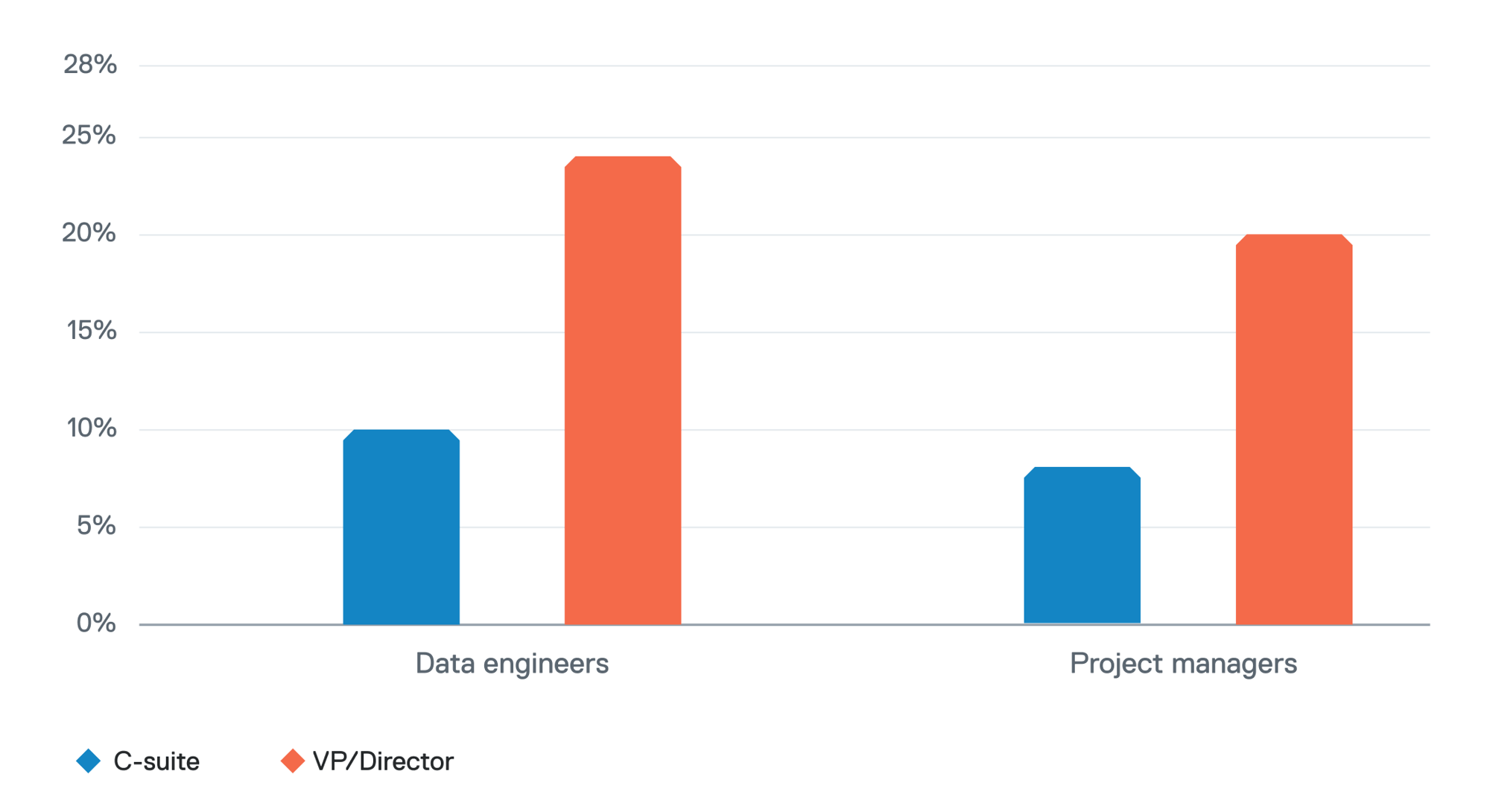
Nowhere is the split clearer than in hiring for data engineers and project managers. A deeper analysis of respondent-level data shows that vice presidents and directors at large enterprises hire data engineers at more than twice the rate of C-suite executives (24% vs. 10%) and project managers at nearly triple the rate (20% vs. 8%). The differences are still statistically significant even after excluding independent software vendor executives from the comparison, which removes the distorting effect of their unusually aggressive hiring.
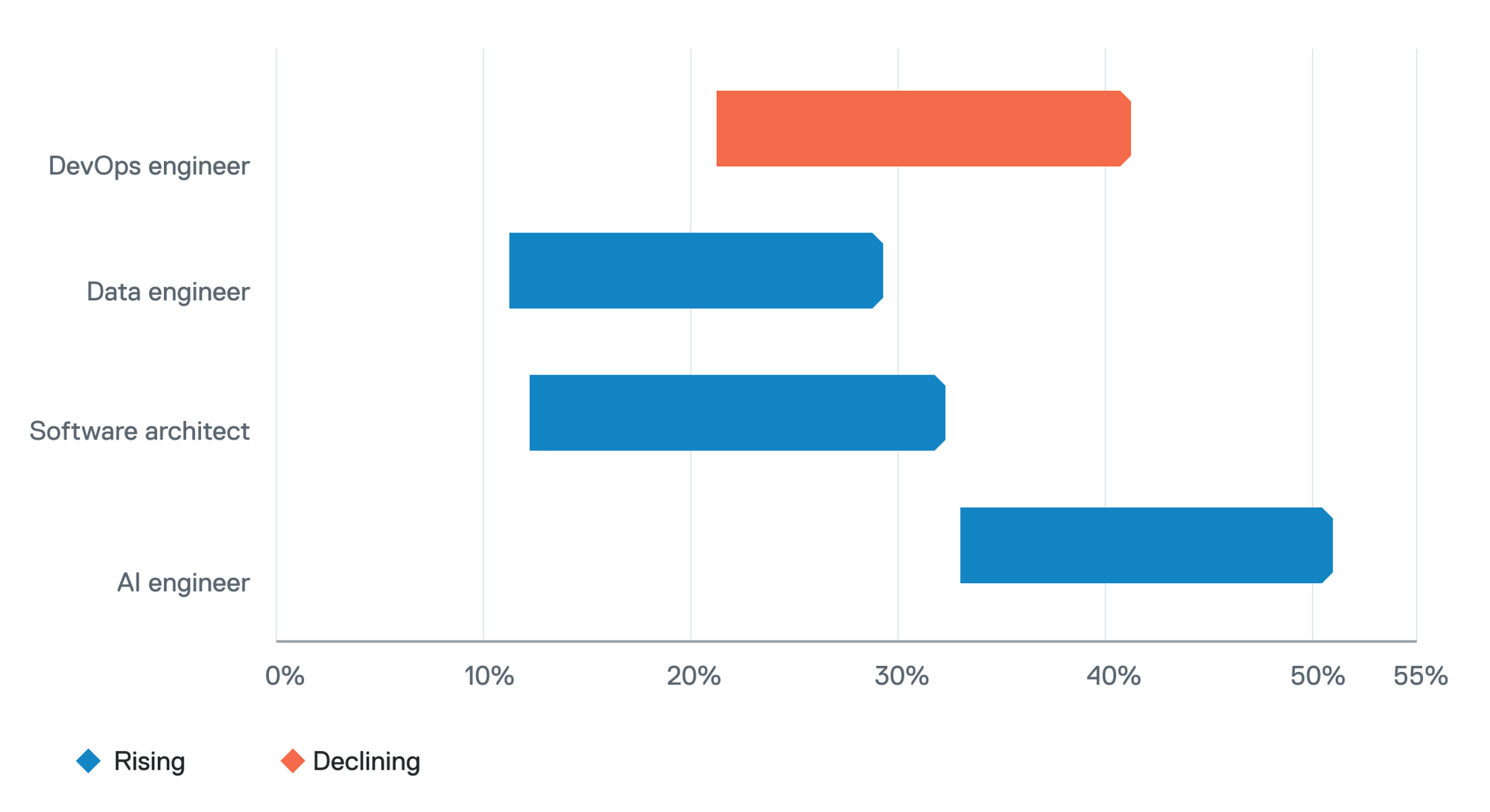
This swing also offers glimpses of how technical roles evolve. Serge Haziyev, SoftServe's Chief Technology Officer for Advanced Technologies, describes the emerging "intelligence engineer" as an “operator of agents, able to configure them” and “feed them with proper context." It’s a role that sits squarely within the operational capabilities that VPs and directors are developing already — even as C-suite hiring for these supporting positions trails behind.
Independent research points in the same direction. Robert Half's 2026 technology job market report ranks data engineers and IT project managers among the year’s most in-demand roles, alongside DevOps and AI engineers. It also finds that 71% of tech leaders have seen skills shortages delay projects over the past year, with AI integration initiatives affected more than any other category tracked — a record high for Robert Half.
The pattern isn't unique to software engineering leadership, either. In fact, agentic AI skills score lowest of the 14 capabilities Workera measured in its latest benchmark report, which draws on more than 88,000 verified skills assessments across major enterprises and the U.S. federal government. Only 13% of employees, its report found, tested as proficient before any AI training. Workforce competency is lagging leadership ambition broadly, not only in this one dataset.
This offers organizations something concrete to act on. Boston Consulting Group’s own research on AI execution finds that changes to operating models and how work gets done drives 70% of AI’s value, versus 10% from algorithms and 20% from data. Closing this specific divide, then, looks less like a hiring-budget fix and more like a visibility problem. Few organizations check whether the C-suite and its VPs and directors are hiring against the same assumptions — about who builds the data pipelines and who coordinates delivery across agents and teams. Agentic AI is forcing this organizational work to the surface alongside the technology itself.
The report found that coding’s share of predicted AI gains drops from 44% in year one to 25% by year three, while end-to-end product development climbs from 27% to 37% over the same period. Engineers, in other words, will move from writing code toward managing the software lifecycle. Project managers and data engineers are close to that change — one coordinates delivery across teams and agents, while the other feeds the agents the data they need.
Whether AI can deliver isn't in question at any level, according to our latest analysis. Nearly every respondent (98%) expects the speed of software delivery to increase over the next two years, by an average of 37%. Confidence across the C-suite, VPs, and directors ranks alike. But hiring the people who make that speed possible doesn't move as evenly.
That unevenness could mean a few things. The C-suite may trust VPs and directors to build the operational bench without needing to mirror that hiring at its own level — a division of labor working as intended. Or hiring plans at the top of the house may not have caught up with where the operational work has moved already. While the data shows the split, it doesn’t settle which explanation is correct — though research suggests it stems from a misalignment between hiring ambitions and workflow change.
Either way, experts and executives agree that AI has already changed talent acquisition — and will continue to change it. The challenge going forward, then, will be whether the C-suite’s hiring plans for the next two years match those their VPs and directors are executing. That comparison plays out differently across industries, influenced by each sector’s own governance, integration, and cost barriers—specifics worth checking before the next budget cycle locks in.