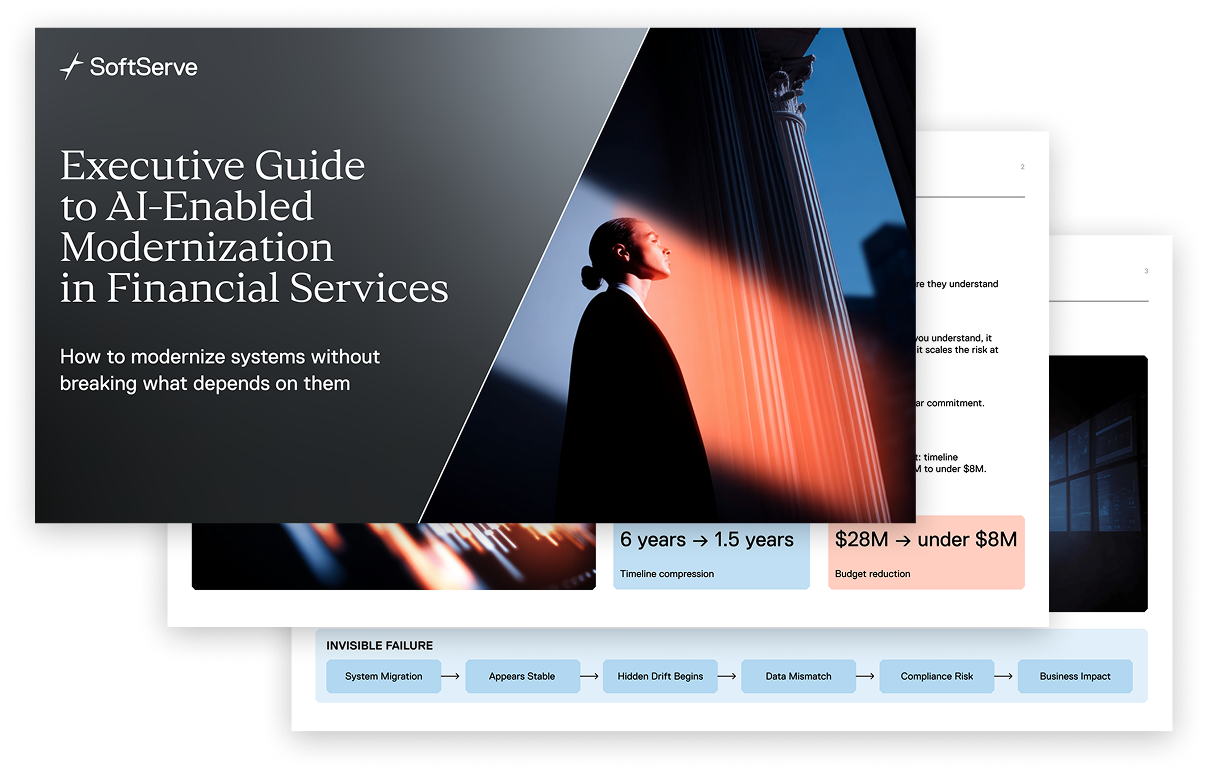
Your modernization plan is only as good as your understanding of what you're modernizing.
Modernization programs in financial services don't fail at go-live. They fail in the weeks after -- when silent drift surfaces as a reconciliation gap, a compliance threshold out of tolerance, or a regulatory report that no longer reflects system reality.
The root cause is not complexity. It is moving systems before you understand what they actually do.
Legacy systems hold decades of business logic that was never documented. When you move the visible parts without extracting the invisible ones, the invisible ones arrive broken -- or pass testing and fail in production.
AI makes this faster in both directions. Apply it to a system you understand and it compresses years into weeks. Apply it to a system you don't and it scales the risk at the same speed.
This guide gives you a structured path:
-
How to assess what your systems actually do - not what documentation says they do
-
Where undocumented logic concentrates risk across core, data, and channel systems
-
How to sequence changes so dependencies don't become production failures
-
A four-week assessment model that produces a business case before you commit to a program
One re-architecture that started here: timeline from six years to 1.5. Budget from $28 million to under $8 million.
Digital Twins for Modern Production Systems
Manufacturers are under pressure to increase output, accelerate launches, and improve sustainability all at once. Yet traditional commissioning and physical testing remain costly, slow, and disruptive.
Simulation, virtual commissioning, and digital twins offer a better way.
In this whitepaper, you’ll see how manufacturers use high-fidelity simulation and real-time digital replicas to design, test, and refine production systems before changes reach the shop floor.
Discover how a connected digital thread across engineering, automation, and operations enables faster launches, higher OEE, and more resilient factories.
GET THE GUIDE