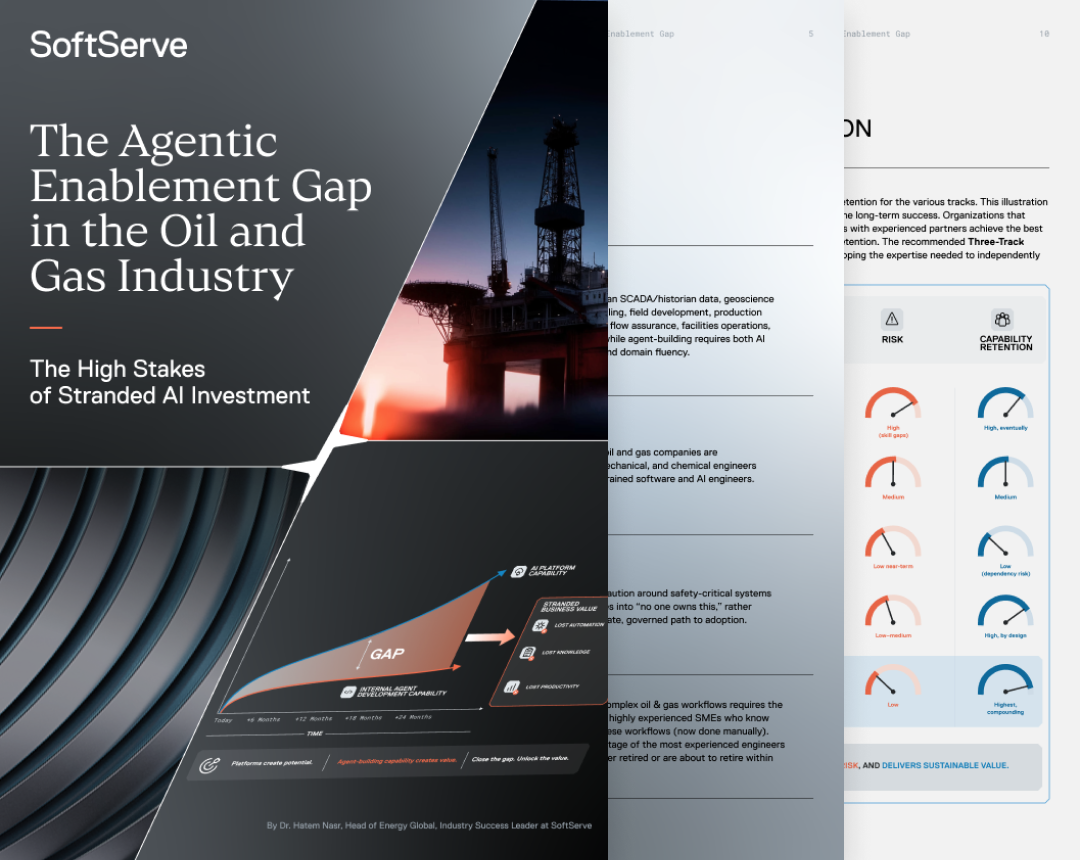
Bridging the Enablement Gap for AI Investments in Oil & Gas
Oil & gas companies have invested heavily in enterprise AI systems and cloud AI platforms. Credit is due where it is earned: the major AI companies and cloud providers have built excellent tools and ecosystems that are improving quickly on every release cycle. AI technology is not the constraint, but enablement and execution are. AI Platforms, provided by the hyperscalers and AI companies, create tremendous potential for building extremely advanced agentic AI systems that can automate highly complex workflows.
What has not kept pace is the internal capability in many oil and gas companies to put that technology to work. Architecting, building, and productionizing agents require highly skilled AI engineers and domain experts. Oil & Gas companies have already made huge investments in AI platforms. Now they must focus on the agentic execution race and achieving the ROI from these investments.
Many AI initiatives across all industries demonstrate value in POCs and pilots, but far fewer successfully transition into production and everyday use. The biggest barriers are often not the AI itself, but data readiness, integration, security, reliability, governance, skills, and user adoption. It highlights why enterprise AI enablement is critical to turn experimentation into sustainable business value.
Companies that build strong agent-development capabilities will now compound advantages through faster cycle times, workflow automation, and better decision support in core operations like exploration, drilling, production, HSE, and trading. Those that don't will fall further behind with every platform release cycle.
Digital Twins for Modern Production Systems
Manufacturers are under pressure to increase output, accelerate launches, and improve sustainability all at once. Yet traditional commissioning and physical testing remain costly, slow, and disruptive.
Simulation, virtual commissioning, and digital twins offer a better way.
In this whitepaper, you’ll see how manufacturers use high-fidelity simulation and real-time digital replicas to design, test, and refine production systems before changes reach the shop floor.
Discover how a connected digital thread across engineering, automation, and operations enables faster launches, higher OEE, and more resilient factories.
GET THE GUIDE